
Blog
How to Convert Ah to kWh and Compare Two Batteries

Volts times amp hours, divided by 1000. That is the conversion. A 280Ah battery at 12.8V holds 3.58kWh, and a 200Ah battery at 24V holds 4.8kWh, which is why amp hours on their own tell you nothing.
The answer first: 280Ah at 12.8V is 3.58kWh
When people reach this question, they are usually holding a quote. Somebody has written 280Ah on it, and you want to know what that means in the units your inverter and your bills actually use.
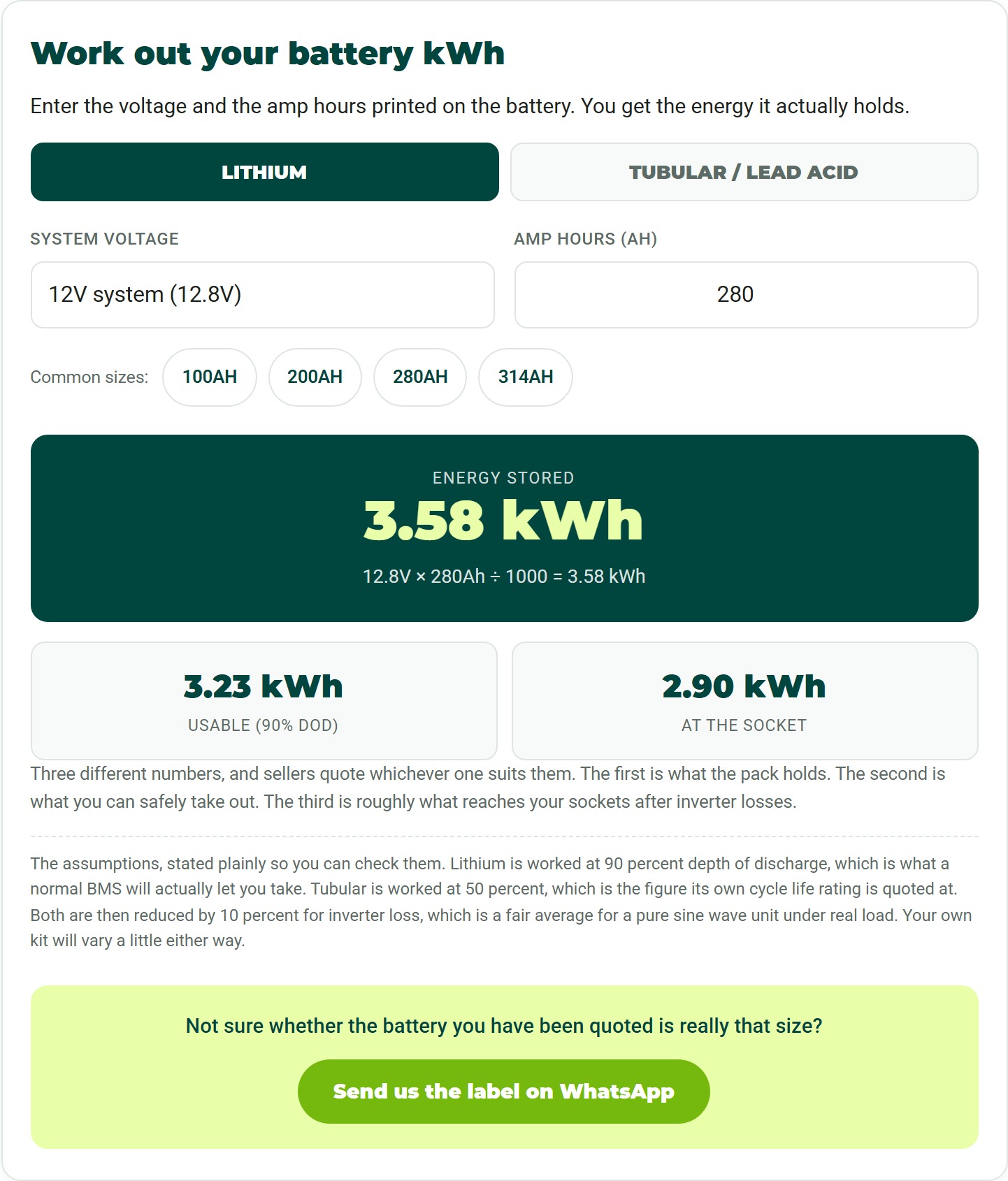
So here is the sum. 12.8 multiplied by 280 gives 3584 watt hours. Then divide by 1000 and you have 3.58 kilowatt hours. In other words it is the same battery everyone else sells as a 3.6kWh unit, rounded up a little.
How many kWh is a 280Ah battery?
At 12.8V a 280Ah lithium battery holds 3.58kWh. When the same 280Ah sits at 25.6V it gives 7.17kWh, and at 51.2V it gives 14.34kWh. Because the amp hour figure is identical in all three, the voltage is doing all the work.
Two quotes that arrived in the same week
Here are two real shapes of quote, and the rest of this post follows them to the end. Both were for the same house and roughly the same money.
- Quote A. Tubular batteries at 12V, 400Ah in total.
- Quote B. One lithium battery at 51.2V, 100Ah.
Four hundred against one hundred. On the paper in front of you, quote A looks four times the battery, and most people stop reading there. But run both through the formula and A holds 4.8kWh while B holds 5.12kWh. So the battery that looked four times smaller is already the bigger one.
And that is before either of them has powered anything. Keep the two numbers in mind, because they move again twice before the end.
The formula
First, amp hours tell you how much current a battery can push, and for how long. Then volts tell you the pressure behind that current. Neither one is energy by itself. But multiply the two together and energy is exactly what you get.
So watt hours equal volts times amp hours. Kilowatt hours are that same figure divided by 1000. Nothing else goes into it, and no seller can argue with the arithmetic.
However, one part does catch people out, and it is the voltage. A 12V lithium battery is really 12.8V, because it holds four lithium iron phosphate cells in series at 3.2V each. A 24V pack is 25.6V and a 48V pack is 51.2V. Instead of that, tubular batteries use the round numbers, so a 12V tubular really is 12V.
How do you convert Ah to kWh?
Multiply the voltage by the amp hours, then divide by 1000. So 24V times 200Ah gives 4800 watt hours, which is 4.8kWh. However, use the real nominal voltage for lithium, which is 12.8V, 25.6V or 51.2V rather than the round number printed on the box.
Doing that by hand for every line of a quote gets old quickly. Our Ah to kWh calculator works it out as you type, and it also shows how much of the energy you can genuinely use.
Why 24V 200Ah and 48V 100Ah are the same energy and different systems
Quote B is a 48V system, and that is not an accident. Take a 24V 200Ah pack and a 48V 100Ah pack. 25.6 times 200 gives 5120 watt hours, and 51.2 times 100 also gives 5120. Both are 5.12kWh, so on paper you are looking at the same battery twice.
Yet inside a house they behave nothing alike. Because the lower voltage pack has to move twice the current for the same power, it heats cables, wastes energy and trips breakers sooner. So the cable has to be thicker, which costs more and is harder to terminate properly.
Bigger systems move to 48V for exactly that reason. If your quote is for anything above about three kilowatts of load and it is built at 24V, ask why. There may be a decent answer, and there may not be.
Is a 200Ah battery bigger than a 100Ah battery?
Not necessarily, because it depends on the voltage. A 24V 200Ah pack and a 48V 100Ah pack hold exactly the same 5.12kWh. So amp hours only compare fairly between batteries at one voltage, while kWh compares fairly between any two batteries at all.
What the Ah figure hides
Now the two quotes move apart for the second time. Neither battery gives you everything it holds, and they do not give up the same share of it.
- Chemistry. Because lithium gives you about ninety percent of what it holds, while tubular gives you about half before you start shortening its life.
- The inverter. Whatever survives that first cut loses roughly another tenth on its way to your sockets.
- Cell quality. Even with identical labels, two packs can hold different capacity on day one and then age at very different speeds.
So quote A drops from 4.8kWh to 2.4kWh usable, and then to about 2.16kWh at the socket. Quote B drops from 5.12kWh to 4.61kWh, and then to about 4.15kWh. The quote advertising four hundred amp hours delivers a little over half of what the hundred amp hour one does.
Why does my battery not give me its rated kWh?
Because no battery is emptied completely, and your inverter takes a cut on the way through. Lithium gives you roughly ninety percent of the rating, while tubular gives about half. So after inverter losses a 3.58kWh lithium pack puts about 2.90kWh into your sockets.
This is also why the two chemistries are never compared on the rated figure alone. We went through that properly in lithium vs tubular batteries, with the numbers over four years rather than one evening.
Comparing two quotes properly
Once you can convert, comparing becomes mechanical. Work through it in this order and quote A stops looking like the bigger battery at step two, long before anybody mentions price.
- First, convert every battery on both quotes to kWh, using the real voltage rather than the rounded one.
- Then cut the lithium figure to ninety percent, and the tubular figure to half. Now you are comparing what you can actually use.
- Next, take another tenth off for the inverter, which gives you what arrives at your sockets.
- After that, divide by what your house uses in an evening, so you end up with hours of backup rather than a specification.
- Only then look at the two prices.
Of course, knowing what your house uses in an evening is the other half of this. So our free guide on what size inverter battery for my house walks that calculation through with a real load list.
Now do it to your own quote
Find the battery line. Write down the voltage and the amp hours, multiply them, divide by 1000. If the voltage is missing from the quote entirely, that absence is your first answer about the seller.
Then run the two cuts. Whatever number you are left with is the one that decides whether your fan is still turning at 5am, and it is the only one worth comparing between two pieces of paper.
Send us a photo of the quote and we will do it with you, line by line. Message us on WhatsApp on +234 809 988 9885, or run the numbers yourself with the Ah to kWh calculator.