
Blog
Power Consumption Meter Nigeria: Know Exactly What Your Appliances Cost You

Before you spend millions on a solar system, spend a few thousand on a wattmeter. It might be the smartest investment you make — because the number one reason solar systems “don’t work” in Nigeria is that nobody measured the load properly in the first place.
What’s in This Guide
- The Sizing Problem
- What is a Power Consumption Meter?
- How It Works (It’s Simple)
- Using It to Size Your Solar + Battery System
- Using It to Save Money on Your Light Bill
- Specifications
- Frequently Asked Questions
- Where to Buy in Nigeria
The Sizing Problem
I’ve had this conversation hundreds of times. Someone calls or sends a WhatsApp message saying they want solar. First question I ask: “What do you want to power?”
The answer is usually something like “my fridge, fan, TV, lights, and maybe the AC sometimes.”
OK. But how much power does your specific fridge actually use? Not what the manual says — what does it actually draw? Because a fridge that says 150W on the sticker might only average 80W (the compressor cycles on and off). Or it might be old and pulling 200W because the compressor is struggling.
Your “small fan” might be 30W or 75W depending on the model and speed setting. Your TV might be 60W or 180W depending on size and type.
When you’re sizing a solar system that costs ₦1.5M to ₦5M, the difference between guessing and measuring is the difference between a system that works and one that disappoints.
So basically, this is the tool that closes that gap.
What is a Power Consumption Meter?
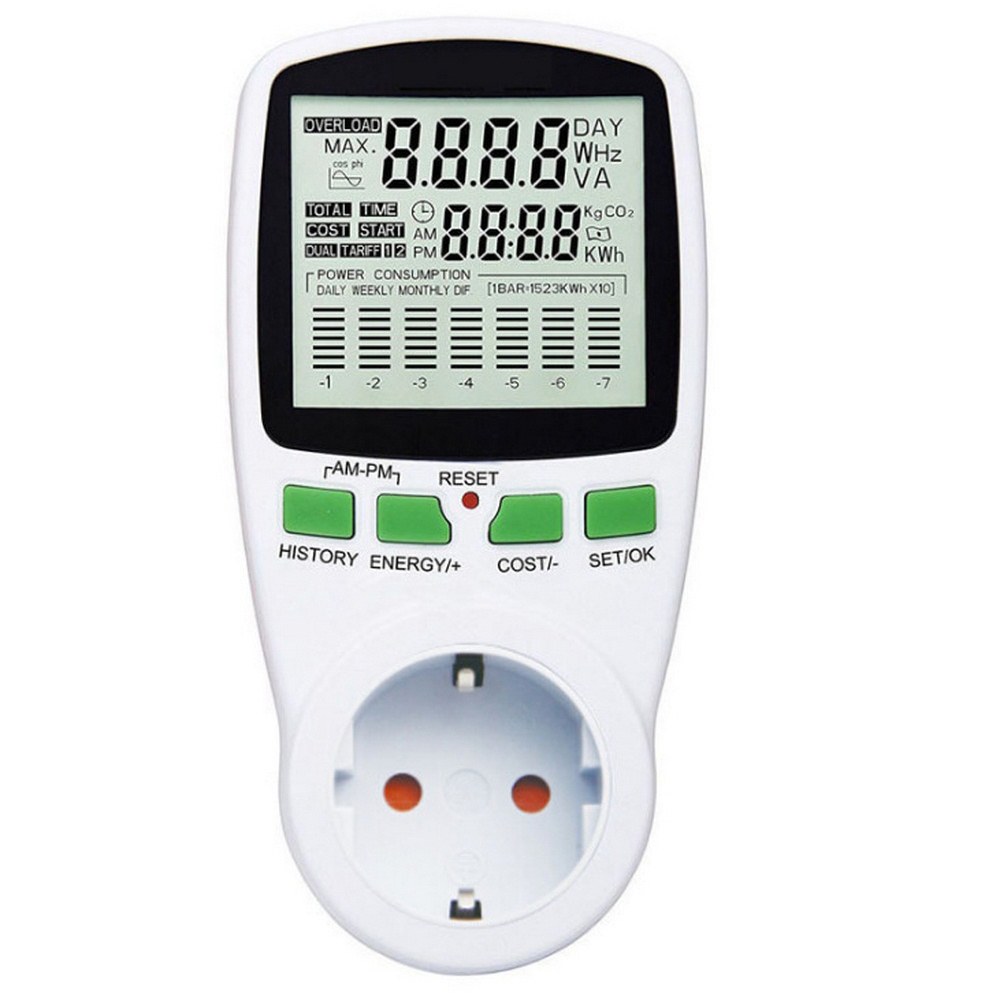
A power consumption meter (also called a wattmeter, energy meter, or electricity usage monitor) is a small plug-in device that sits between your wall socket and your appliance. It measures exactly how much electricity that appliance uses — in real time and over time.
You plug it into the wall. You plug your appliance into it. Then you go about your day. The meter tracks everything.
It shows you watts (how much power the appliance is using right now), kilowatt-hours (total energy consumed over time), voltage, current, frequency, power factor, and — this is the one that gets people’s attention — cost.
You can set your electricity tariff rate and the meter will calculate exactly how much each appliance is costing you per day, per week, per month.
How It Works (It’s Simple)
There’s no installation, no wiring, no electrician needed. Three steps:
Step 1: Plug the wattmeter into your wall socket.
Step 2: Plug your appliance (fridge, TV, fan, AC, anything) into the wattmeter.
Step 3: Read the display.
That’s it. The screen shows you real-time power consumption in watts. Leave it plugged in for 24 hours and you get total kWh consumed in a full day — which is exactly what you need for sizing a solar system.
The buttons cycle through different readings: power (watts), energy (kWh), voltage (V), current (A), frequency (Hz), power factor (cos φ), and cost. The HISTORY button shows you accumulated readings over time.
Using It to Size Your Solar + Battery System
This is where it gets really practical. Here’s the method we recommend to every client considering a solar system:
Example: Sizing a Home Solar System
Week 1: Plug the wattmeter into your fridge for 24 hours. Note the kWh reading. Let’s say it shows 1.2kWh/day.
Repeat for each major appliance:
- TV: 0.3kWh
- Fans ×3: 0.6kWh total
- Lights: 0.4kWh
- Laptop charger: 0.2kWh
Total daily load: 1.2 + 0.3 + 0.6 + 0.4 + 0.2 = 2.7kWh per day
Battery sizing: For a system that gives you 12 hours of backup, you need at least 2.7kWh of usable battery capacity. With a LiFePO4 battery at 90% depth of discharge, that’s a 3kWh battery — our 3.6kWh Deriy unit handles this comfortably with margin.
Panel sizing: To recharge 2.7kWh in 4-5 peak sun hours, you need roughly 600-700W of solar panels.
The point: Without measuring, someone might have quoted you a 5kW system when a 3.6kWh system does the job — saving you over a million naira.
Now compare that to the other approach — the one where the installer just asks “how many bedrooms?” and quotes you based on assumptions. You can see why systems get oversized (wasting your money) or undersized (leading to disappointment).
Pro Tip: The Prepaid Meter Method
If you have a prepaid meter, there’s an even faster approach — check your meter’s daily kWh consumption over a week and average it. But the wattmeter method is better because it tells you which appliances are the energy hogs, so you can make smart decisions about what goes on solar and what doesn’t.
Using It to Save Money on Your Electricity Bill
Even if you’re not going solar yet, a wattmeter pays for itself quickly.
Most people have no idea which appliances are draining their prepaid meter. They just know the units disappear fast. A wattmeter gives you the data to make changes.
Common surprises people discover:
That old chest freezer is using 3x what a modern one would. The water heater left on standby all day is burning units even when nobody’s using hot water. The “energy saving” bulbs they bought from the market are actually pulling more watts than advertised. The phone charger left plugged in 24/7 is drawing phantom power (not much per charger, but multiply by 6 chargers across the house…).
Knowledge is money. Once you know where the energy goes, you can make informed decisions about what to replace, what to schedule, and what to put on a timer.
Specifications
| Parameter | Specification |
|---|---|
| Measurement Range (Power) | 0 – 3,680W |
| Voltage Range | 230V AC (±10%) |
| Current Range | 0 – 16A |
| Energy Measurement | 0.000 – 9,999.9 kWh |
| Frequency | 50Hz / 60Hz |
| Display | Large LCD digital display |
| Parameters Shown | Watts, kWh, Voltage, Current, Frequency, Power Factor, Cost |
| Cost Calculation | Programmable tariff rate |
| History Function | Daily, weekly, monthly consumption tracking |
| Overload Indicator | Visual warning on display |
| Plug Type | Available in EU/US/UK plug versions |
| Memory | Retains data during power outages |
Which Plug Version for Nigeria?
Nigeria primarily uses UK-style Type G (three rectangular pins) sockets. When ordering, make sure you select the UK plug version. The EU version (two round pins) will work with many Nigerian sockets that accept round pins, but the UK version gives you a proper fit with the standard 13A socket. We stock the version that works with Nigerian sockets.
Frequently Asked Questions
Is this the same as a prepaid meter? No. Your prepaid meter measures total house consumption. This meter measures individual appliances, one at a time. It’s a diagnostic tool that shows you where your electricity goes — think of it like an X-ray for your power usage.
Can I leave it plugged in permanently? Yes. Many people leave it on their fridge permanently to track monthly consumption. It draws negligible power itself (less than 0.5W).
Will it work during NEPA/PHCN power outages? The meter only measures when power is flowing. During an outage, it stops measuring but retains its stored data in memory. When power returns, it continues accumulating from where it left off.
Can I use it to measure my generator’s output? Yes. Plug it into a generator-powered socket and connect your appliance. It’ll show you exactly what that appliance draws from the generator — useful for generator fuel consumption planning too.
Can it measure my whole house at once? No — it measures one socket/appliance at a time (up to 16A). For whole-house monitoring, you’d need a DIN-rail energy meter installed in your distribution board by an electrician. This plug-in meter is designed for individual appliance measurement.
How does this help me decide on a solar system? By measuring each appliance individually over 24 hours, you build an accurate picture of your daily energy consumption in kWh. This number — not guesswork, not estimates — is what should determine your battery size and solar panel capacity. It prevents you from buying too much system (wasting money) or too little (getting disappointed).
Can I set my PHCN/DisCo tariff rate? Yes. The cost function lets you input your per-kWh tariff rate. Once set, the meter calculates exactly how much each appliance costs you to run — per day, per week, or per month.
Buy the Power Consumption Meter in Nigeria
Intelligent AC Power Consumption Meter Measures Watts, kWh, Voltage, Current, Frequency, Power Factor & Cost Plug-and-play — no installation needed. Ships nationwide from Port Harcourt.
Questions? WhatsApp us: +234-809-988-9885
Ready for the Next Step? Once you know your actual consumption, you’re ready to size a proper solar + battery system. We specialise in LiFePO4 lithium batteries — 6,000+ cycle life, 10-year warranty, and they actually deliver their rated capacity (unlike tubular batteries at 50% depth of discharge). Get a quote based on your real numbers →