
Blog
Lithium Battery Capacity: Why 5kWh Only Gives 4.5kWh

A 5kWh lithium battery gives you about 4.5kWh you can safely use, and roughly 4.05kWh actually reaches your sockets. Nothing is faulty when that happens. Lithium battery capacity is quoted three different ways, and four parties take a cut before you see any of it.
What lithium battery capacity on the sticker means
First, the figure on the box is the nameplate capacity. It is what the pack holds when it is completely full, measured in a factory, at a comfortable temperature, by somebody who wants the number to look good.
So it is not a promise about your house. Lithium battery capacity on a box is the starting figure, before anything in the real world has taken its share.
Because every honest seller is quoting that same starting figure, comparing two batteries on it is fair. The trouble begins when one of them calculates it differently from the other.
How rated capacity is calculated
So volts multiplied by amp hours, divided by 1000. That is the whole sum, and we worked it through in how to convert Ah to kWh.
However, which voltage goes into that sum is where the first cut happens, long before you ever see the battery. A lithium iron phosphate cell sits at 3.2V nominal, so a four cell pack is 12.8V and a sixteen cell pack is 51.2V. Use those and the answer is honest.
But a fully charged cell reads about 3.65V, and nothing stops a seller doing the sum at that figure instead. So a 12.8V 280Ah pack that genuinely holds 3.58kWh can be advertised as a 4kWh battery, and the arithmetic behind it is not even wrong. It is just measured at a voltage your battery spends almost none of its life at.
Indeed, we were doing a version of this ourselves. Our 51.2V 314Ah packs carried 17kWh in their product names, which is the figure you get at about 3.4V per cell. At the real nominal voltage they hold 16.08kWh, so we renamed all three in September 2026. If you had bought one before that, you got the battery you paid for and a name that overstated it.
Where the missing kWh goes
Now the cuts that take lithium battery capacity down after the pack reaches your wall. There are three, they are all normal, and together they are the gap between the sticker and your fan at 5am.
- The BMS takes the first cut. It stops the pack being emptied completely, because a cell taken to zero is a damaged cell. On a decent lithium pack that leaves you about 90 per cent.
- The inverter takes the second. Turning stored direct current into the alternating current your sockets use costs roughly a tenth of whatever passes through it.
- Time takes the third. Cells lose a little capacity every year, faster if they run hot, which in Nigeria they usually do.
So the first two are already in the numbers below. The third is why a four year old battery does not behave like it did in week one, and why cycle life matters as much as capacity.
Why does my battery not give the rated capacity?
Because the factory measures it on a full pack, before the BMS reserve and the inverter loss come off. A pack that delivers about 80 per cent of its nameplate into your sockets is working exactly as designed. Below roughly 70 per cent, something is genuinely wrong.
Nameplate, usable and delivered: three different numbers
So here is the same lithium battery capacity described three honest ways. Sellers quote whichever of the three suits them, and none of them is lying.
| Battery | Nameplate | Usable at 90% | At the socket |
|---|---|---|---|
| 5kWh pack | 5.00 kWh | 4.50 kWh | 4.05 kWh |
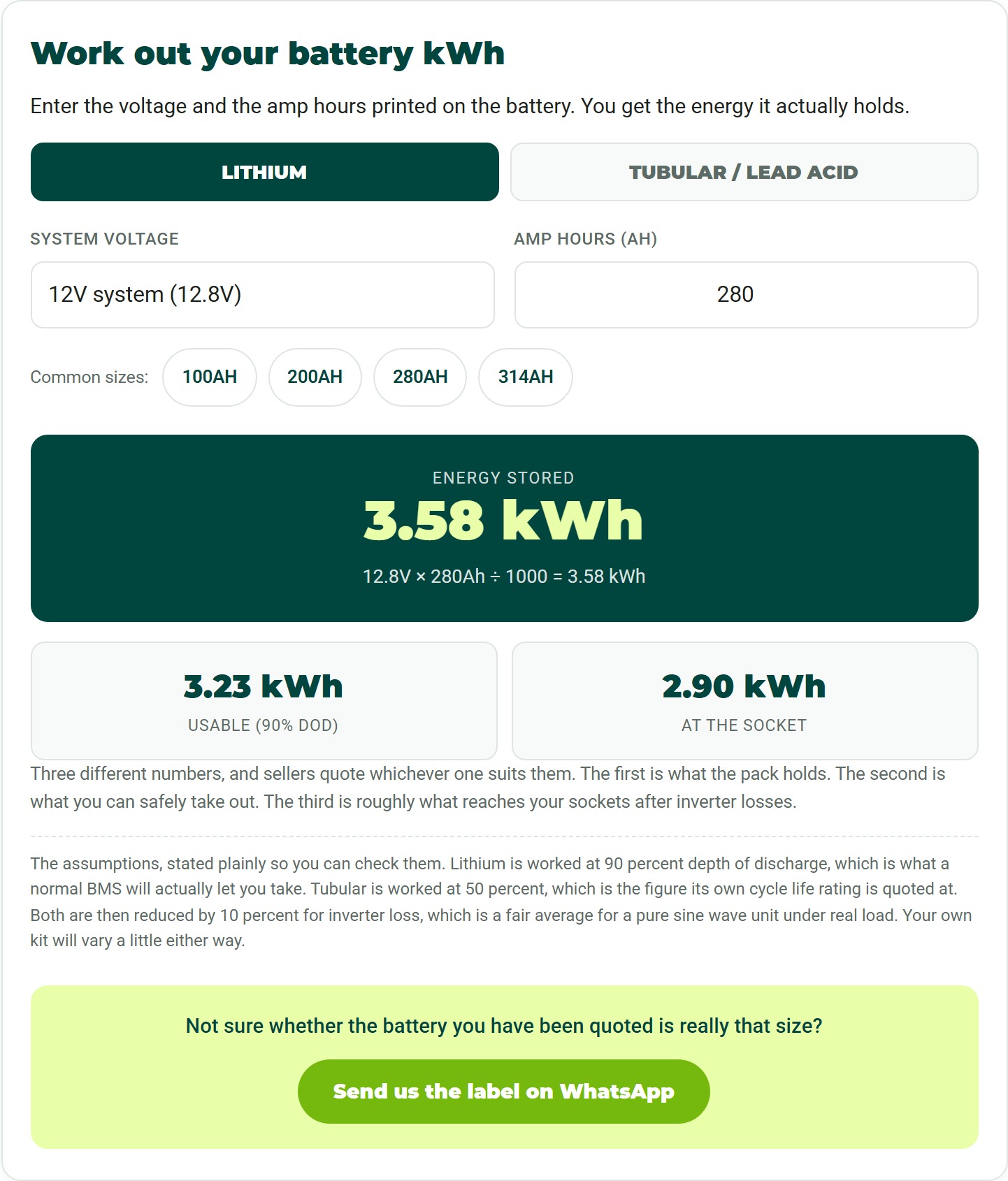
| 12.8V 280Ah | 3.58 kWh | 3.22 kWh | 2.90 kWh |
| 51.2V 314Ah | 16.08 kWh | 14.47 kWh | 13.02 kWh |
What is the difference between rated and usable capacity?
Rated capacity is everything the pack holds. Usable capacity is what the BMS will let you take out without shortening the battery’s life. For lithium that gap is about a tenth, and for tubular it is about half, which is why the two cannot be compared on the rated figure.
How much usable power is in a 3.6kWh battery?
About 3.22kWh usable, and roughly 2.90kWh once the inverter has taken its share. Most so-called 3.6kWh packs are really 3.58kWh, because they are 12.8V 280Ah units rounded up. Run your own figures through our Ah to kWh calculator.
How to check the label yourself
Now, everything above is checkable in about a minute, standing in front of the battery, without any equipment.
- First, find the nominal voltage, not the charge voltage. It should read 12.8V, 25.6V or 51.2V on a lithium pack.
- Multiply it by the amp hours and divide by 1000. That is the real nameplate figure.
- Next, compare it with the kWh printed on the front. If the printed number is bigger, ask which voltage they used.
- Then take off a tenth for the BMS and another tenth for the inverter. That is what your house actually gets.
If those two figures disagree by more than rounding, you have not necessarily found a fake. You have found a marketing decision, and it tells you something about who you are dealing with.
What to get in writing
Still, checking the label only protects you on the day. Getting it in writing protects you in year three, when the pack is not holding what it used to and the conversation turns into your word against theirs.
So ask for three things on the invoice: the nominal voltage, the amp hour rating, and the cycle life with the depth of discharge it they measured it at. A seller who will put all three in writing is telling you the number is real. One who will not has just answered a different question.
Send us any label or quote and we will work the three figures out with you. Message us on WhatsApp on +234 809 988 9885. If the units themselves are the confusing part, kVA, kW and kWh explained covers those, and our free guide on what size inverter battery for my house turns the delivered figure into hours of backup.