
Blog
Before You Buy That Tubular Battery: What You Really Need to Know

So you’re about to buy a tubular battery. Maybe it’s because the price seems more manageable than lithium. Maybe it’s what your installer recommended. Maybe everyone in your compound uses tubular and it feels like the safe choice.
Before you hand over that ₦300,000, there are some things about tubular batteries that sellers won’t tell you. Not because they’re dishonest – but because they assume you already know, or they’d rather you didn’t ask.
This isn’t an article to bash tubular batteries. They’ve powered Nigerian homes for decades, and they still have a place in the market. But if you’re going to buy tubular in 2025, you should understand exactly what you’re getting – and what it will actually cost you over time.
Let’s use a real example: a popular 220Ah tubular battery selling for around ₦300,000 in Nigerian stores.
Understanding What You’re Actually Buying
When you see “220Ah” on a tubular battery, here’s what that actually means for your home:
The Real Capacity
Nominal capacity: 220Ah × 12V = 2.64kWh total
Usable capacity: 1.32kWh (you should only discharge to 50%)
Why only 50%? Because draining tubular batteries below 50% significantly reduces their lifespan. Take them to 80% discharge regularly and your “2-3 year” battery becomes an “8-12 month” battery.
What 1.32kWh actually powers:
- 4 LED bulbs (10W each) for 6 hours = 240Wh
- 2 ceiling fans (75W each) for 6 hours = 900Wh
- Small fridge for 1 hour = 150Wh
- Total: 1,290Wh (1.29kWh)
That’s it. That’s your daily backup power from a ₦300,000 battery that weighs 60kg and takes up floor space in your home.
For comparison, a 3.6kWh lithium battery (₦690,000) gives you 3.2kWh usable capacity – 2.4 times more power and consumes far less space!
The Specs They Give You (And What They Mean)
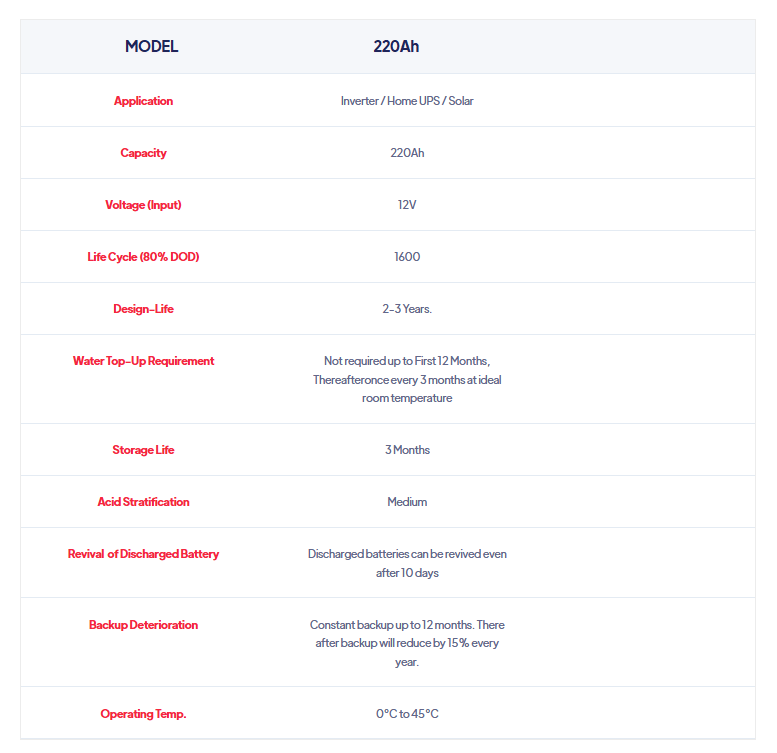
Let’s break down the Luminous spec sheet honestly:
“Life Cycle: 1,600 at 80% DoD”
This sounds impressive until you understand what it means:
- 1,600 cycles at 80% discharge depth
- But you’re only supposed to use 50% per day to preserve lifespan
- In Nigerian reality with irregular power, you’ll often go deeper than 50%
Real-world translation: Expect 800-1,200 actual cycles before noticeable capacity loss.
“Design Life: 2-3 Years”
This is the manufacturer being honest. Your tubular battery will last 2-3 years if properly maintained and not over-discharged.
Notice they don’t say “5-year warranty” or “10-year lifespan” – they say 2-3 years design life because that’s reality.
“Water Top-Up: Not required for first 12 months, thereafter once every 3 months”
Translation: You’ll be buying distilled water and opening that battery to top up cells every 3 months after the first year.
What they don’t mention:
- Finding genuine distilled water (not just “pure water”)
- The mild acid smell during topping
- The risk of overfilling or underfilling
- Checking each individual cell
- Doing this consistently or facing reduced battery life
“Backup Deterioration: 15% reduction every year after 12 months”
This is buried in the specs but it’s crucial:
Year 1: 1.32kWh usable (good performance)
Year 2: 1.12kWh usable (15% loss)
Year 3: 0.95kWh usable (28% total loss)
By year 3, your battery is providing less than 1kWh of daily backup – barely enough to run fans and lights, forget the fridge.
Lithium batteries? They maintain 90%+ capacity for 10+ years.
“Operating Temperature: 0°C to 45°C”
Nigeria regularly exceeds 45°C in many areas. Battery rooms can hit 50°C+ during hot season.
High temperatures accelerate capacity loss in tubular batteries significantly. That “2-3 year design life” becomes “18-24 months actual life” in hot Nigerian conditions.
The Size and Weight Reality
Tubular Battery
- Weight: 55-65kg (one battery)
- Footprint: Requires floor-mounted rack
- For equivalent capacity: Need 2-3 batteries = 120-180kg total
- Installation: Heavy lifting, reinforced flooring recommended
- Mobility: Once installed, not moving it easily
Lithium Battery (3.6kWh)
- Weight: 27kg
- Footprint: Compact, can be wall-mounted
- Equivalent capacity: Single unit = 2.4x more usable power
- Installation: One person can lift it
- Mobility: Relocate if needed
The Maintenance Nobody Mentions
Tubular batteries aren’t “install and forget.” Here’s the actual maintenance schedule:
Every 3 Months (After Year 1)
- Buy distilled water
- Remove battery caps (6-12 caps per battery)
- Check each cell water level
- Top up cells to proper level (not too much, not too little)
- Clean any acid residue on terminals
- Tighten connections
- Replace caps properly
Time required: 30-45 minutes per session
Every 6 Months
- Deep clean terminals with baking soda solution
- Check for corrosion
- Verify charge voltage is correct
- Test battery capacity if possible
Annually
- Professional maintenance check recommended
- Terminal replacement if corroded
- Full capacity test
What happens if you skip maintenance?
- Sulfation builds up on plates
- Capacity degrades faster
- Battery fails before 2-year mark
- Warranty may be voided
Lithium battery maintenance: None. Zero. The BMS handles everything internally.
The True Cost: 5-Year Analysis
Let’s do the real math on tubular vs lithium over 5 years:
Tubular Battery Path (2 Tubular Batteries are Equivalent to 1 of our 3.6KWh Lithium Batteries)
Year 1: ₦600,000 (initial purchase)
Maintenance Year 1: ₦0 (no topping required)
Year 2: ₦20,000 (maintenance)
Year 3: ₦600,000 (replacement)
Year 4: ₦20,000 (maintenance)
Year 5: ₦600,000 (replacement)
5-year total: ₦1,840,000
This is for ONE 220Ah battery providing 1.32kWh usable capacity.
Lithium Battery Path (3.6kWh)
Year 1: ₦690,000 (purchase) Years 2-5: ₦0 (no maintenance, no replacement)
5-year total: ₦690,000
Savings with lithium: ₦1,150,000 over 5 years Plus: 50% more usable power from day one
The Aesthetics Nobody Talks About
Walk into most Nigerian homes with solar, and you’ll see:
- Large floor-standing battery racks
- Exposed terminals and cables
- That distinct battery smell (especially during charging)
- Stained flooring from occasional acid leaks
- Visible corrosion on terminals
It’s functional, but it’s not pretty.
Lithium systems:
- Sleek, finished units
- Wall-mountable in many cases
- No smell
- No leakage
- Clean, modern appearance
If your battery room is visible or near living spaces, aesthetics matter more than you think.
When Tubular Still Makes Sense
To be completely fair, there are scenarios where tubular batteries might still be appropriate:
1. Very Tight Short-Term Budget
If you need backup power immediately and absolutely cannot access ₦690,000, a pair ₦600,000 tubular batteries will work for 18-24 months.
But understand: You’re trading lower upfront cost for:
- Higher total cost over time
- Maintenance burden
- Less usable capacity
- Earlier replacement cycle
2. Temporary Housing (Under 2 Years)
If you know for certain you’ll be in this location for less than 2 years, tubular batteries might outlast your stay.
However: Consider that the lithium battery is portable. You can take it to your next location. The tubular battery? Probably stays behind or becomes a hassle to move.
3. Extremely Basic Power Needs
If you literally only need to run 3-4 LED bulbs and charge phones (less than 300Wh daily), a tubular battery will do this for 2-3 years.
But ask yourself: If your needs are that basic, why not spend slightly more on lithium and have the flexibility to run more when needed?
4. Remote Areas with Limited Support
If you’re in a very remote area where lithium battery support is genuinely unavailable and local technicians only know tubular, this might influence your choice.
Reality check: Most of Nigeria’s urban and semi-urban areas now have lithium battery support networks. If you can receive online deliveries, you can get lithium support.
What to Look For in a “Good” Tubular Battery
If after all this you’re still buying tubular, at least buy quality:
Cell Construction
- Thick tubular plates (not thin)
- Pure lead alloy (verify with supplier)
- Robust plate separators
- Quality electrolyte
Build Quality
- Sealed, well-constructed case
- No visible manufacturing defects
- Proper terminal connections
- Clear labeling and specifications
Brand Reputation
Stick with established brands:
- Luminous (decent quality)
- Trojan (expensive but reliable)
- Genus
- Exide
Avoid no-name brands selling tubular batteries for cheap. They’re using thinner plates and lower-quality materials. They won’t last 12 months.
Warranty Terms
- Minimum 18-month warranty
- Clear warranty terms (what’s covered, what isn’t)
- Local warranty service (not “ship to manufacturer”)
- Prorated replacement policy
Proper Sizing
Don’t under-size. If calculations show you need 4kWh usable:
- Tubular: Need 8kWh total capacity
- Lithium: Need 5kWh total capacity
Trying to save money by under-sizing means constant deep discharging, which kills tubular batteries fast.
The Honest Recommendation
Here’s the truth most sellers won’t tell you: In 2025, buying new tubular batteries for home backup power doesn’t make financial sense for most people.
The math is simple:
- Tubular gives you 1.32kWh usable for ₦300,000, lasts 2 years, requires maintenance
- Lithium gives you 3.2kWh usable for ₦690,000, lasts 5+ years, zero maintenance
Over 5 years:
- Tubular: ₦1,840,000 (3 replacements + maintenance)
- Lithium: ₦690,000 (one purchase)
You’re spending 3x more on tubular batteries over the system’s lifetime while getting less power, more hassle, and constant replacement cycles.
The only argument for tubular is the lower upfront cost. But if you can afford ₦300,000 today, saving for 2-3 more months to buy lithium instead will save you overa million over the next 5 years.
If You Must Buy Tubular
If budget absolutely forces you toward tubular:
- Buy the best quality – cheaper tubular is throwing money away
- Size properly – don’t under-size trying to save money
- Set up maintenance reminders – consistent maintenance extends life
- Never discharge below 50% – configure your inverter cutoff properly
- Plan your upgrade – start saving for lithium now, switch when this tubular fails
Think of tubular as a temporary solution while you save for the real one.
The Better Plan
Instead of buying that tubular battery today:
Option 1: Save for 2-3 more months, buy a 3.6kWh lithium battery
Option 2: Buy a smaller 2.56kWh lithium battery if capacity works
Option 3: Buy the tubular now, but start saving for lithium. In 18 months when the tubular fails, you’ll have enough for the lithium upgrade
The worst plan: Keep buying ₦300,000 tubular batteries every 2 years and spend millions.
Questions to Ask Before Buying Tubular
If you’re still considering tubular, ask yourself:
- Can I handle quarterly maintenance for 2-3 years?
- Do I have space and floor capacity for heavy batteries?
- Am I okay with 15% capacity loss every year?
- Can I afford to replace this in 18-24 months?
- Would saving 2 more months for lithium work instead?
If you answered “no” to any of these, tubular isn’t right for you.
The Bottom Line
Tubular batteries made sense in 2010. They made sense in 2015. By 2020, lithium was becoming competitive. In 2025, continuing to buy tubular batteries is like buying a Nokia 3310 because smartphones are “too expensive.”
Yes, the Nokia is cheaper. Yes, it makes calls. But you’re going to spend more replacing it every 2 years than if you’d bought the smartphone once.
The solar revolution in Nigeria is built on reliable, long-lasting energy storage. Tubular batteries can’t deliver that anymore. The technology has moved on.
If you buy that tubular battery today, you’re signing up for:
- Less usable power
- Quarterly maintenance
- Replacement in 18-24 months
- Higher total cost
- Constant worry about capacity loss
Or you can wait 2 more months, invest in lithium, and never think about batteries again for 15+ years.
The choice is yours. But at least now you know what you’re really choosing.
Still considering tubular? Calculate what battery size you actually need. Questions? Contact our team – we give honest advice even if it doesn’t lead to an immediate sale.
One thought on “Before You Buy That Tubular Battery: What You Really Need to Know”