
Blog
Solar Panel Tester Nigeria: How to Test Your Solar Panels Before You Get Burned

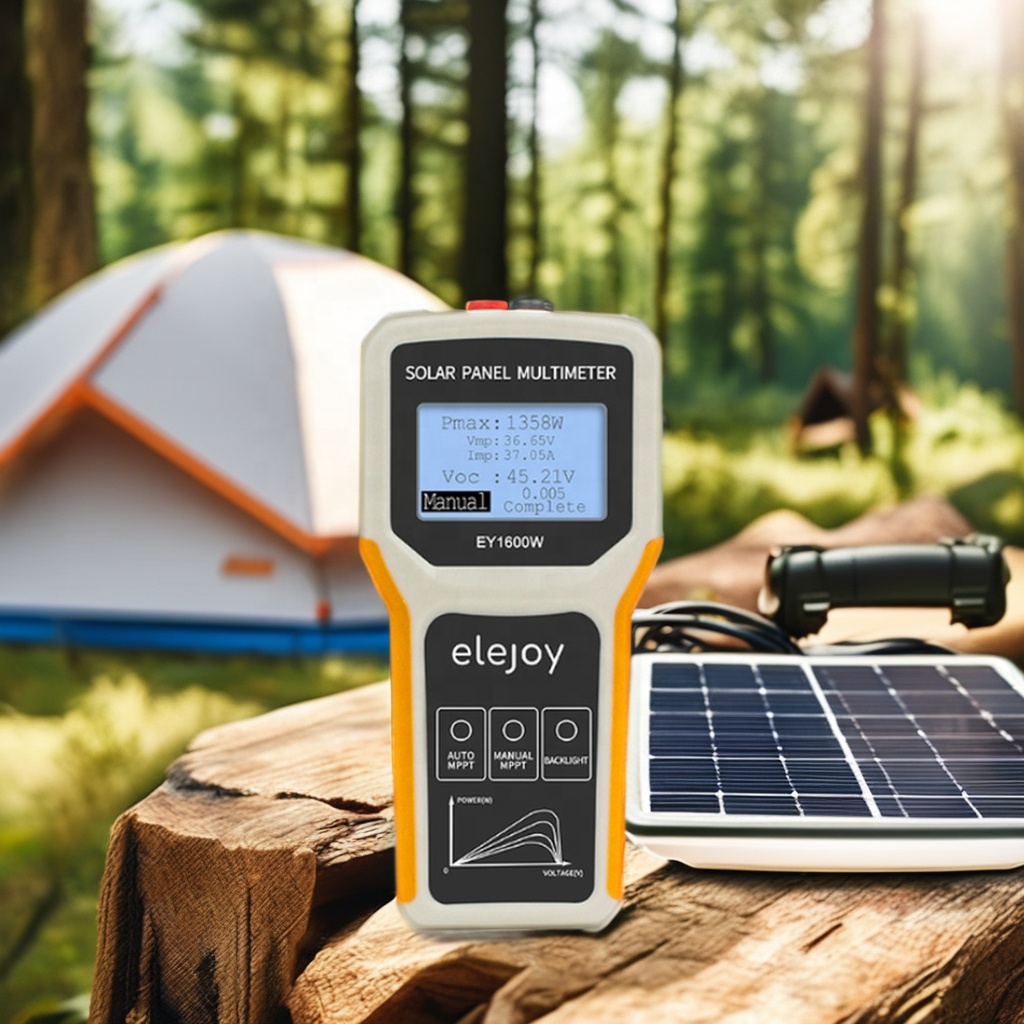
You paid ₦150,000 for a “400W” solar panel. But is it actually producing 400 watts? Here’s how to find out in 30 seconds — and why every installer, dealer, and serious solar owner in Nigeria needs a panel tester.
What’s in This Guide
- The Problem Nobody Talks About
- What is a Solar Panel Tester?
- Why You Need One in Nigeria (Especially)
- Buying Used Solar Panels? Test First.
- The Elejoy EY1600W — What It Does
- How to Use It (Step by Step)
- Diagnosing Panel Problems
- Who Actually Needs This?
- Full Specifications
- Frequently Asked Questions
- Where to Buy in Nigeria
The Problem Nobody Talks About
So here’s something that happens more than people realise in the Nigerian solar market.
Someone buys a set of solar panels — let’s say four 400W panels for a 1.6kW array. They paid good money. The installer puts them on the roof. The inverter shows some charging. Everyone’s happy.
Except… the system never quite performs as expected. The batteries aren’t getting full. The backup time is shorter than promised. And slowly, the customer starts thinking “this solar thing doesn’t really work.”
Nine times out of ten, the panels are the problem. Not because they’re broken — but because they were never 400W to begin with.
I’ve been in the renewable energy space for over 20 years and I’ve lived about 80% off-grid since 2021. In that time, I’ve seen panels labelled 400W that barely push out 280W. I’ve seen “mono PERC” panels that are clearly just relabelled poly panels. And the only way to know for sure is to test them.
That’s where a solar panel tester comes in.
What Exactly is a Solar Panel Tester?
A solar panel tester (also called a PV multimeter or solar panel multimeter) is a handheld device that measures the actual electrical output of a solar panel in real time.
Think of it like this: your panel has a sticker that says “400W.” That’s the manufacturer’s rated output under perfect lab conditions (25°C, 1000W/m² irradiance — basically ideal conditions that rarely exist on a Lagos or Port Harcourt rooftop). The tester tells you what the panel is actually producing right now, on your roof, in your conditions.
It measures four key things:
Pmax (Maximum Power) — this is the big one. The actual watts your panel is putting out at its best operating point. If your “400W” panel shows Pmax of 380W on a sunny day, you’re fine. If it shows 250W, you’ve been shortchanged.
Voc (Open Circuit Voltage) — the voltage when nothing is connected. This tells you if the cells inside the panel are healthy.
Vmp (Voltage at Maximum Power) — the voltage when the panel is working hardest. You need this for sizing your charge controller and inverter correctly.
Imp (Current at Maximum Power) — the current at peak output. Important for wire sizing and safety.
Why You Need One in Nigeria (Especially)
I’ll be direct: the Nigerian solar market has a quality control problem.
We’re one of the biggest solar markets in Africa, which means every manufacturer in the world wants to sell here. The reputable ones stick to their specs. But a significant number of panels coming through our ports are either mislabelled, rejected stock from other markets, or outright counterfeits.
Without a tester, you’re trusting a sticker. With a tester, you have proof.
Real Scenario: An installer buys 10 panels rated 550W each for a commercial project. Total expected array: 5,500W. Without testing, he installs all 10. The system underperforms. The client blames the batteries, the inverter, the installer — everyone except the panels, because “they’re brand new.”
If the installer had tested them on arrival, he’d have caught that three of the ten panels were only putting out 380W each. That’s 510W missing from the array — enough to cause exactly the kind of underperformance the client is experiencing.
Buying Used Solar Panels? Test First.
This is where a panel tester becomes absolutely essential.
Used solar panels are a growing market in Nigeria. People upgrade their systems and sell the old panels. Offices relocate and offload their rooftop arrays. Imported “second-hand” panels come in from Europe and the US where systems get replaced after 10-15 years.
The prices are attractive — sometimes 40-60% cheaper than new. But here’s the thing: you have no idea what you’re getting without testing.
A used panel might look perfectly fine on the outside but have internal issues you can’t see: microcracks in the cells from thermal cycling, degraded connections from years of weather exposure, hot spots that reduce output, or delamination starting to form.
What the tester tells you about a used panel:
Is it worth the price? A “used 300W panel” selling for ₦50,000 sounds great. But if it only produces 180W when you test it, you’re paying ₦278 per watt instead of the ₦167/watt you thought. That might make a new panel the better deal.
How much has it degraded? Solar panels lose about 0.5-0.7% output per year. A 10-year-old 300W panel should still produce around 280W. If it’s showing 200W, something beyond normal aging is wrong — cracked cells, failed bypass diodes, or junction box issues.
Can you match it with your existing panels? If you’re adding used panels to an existing array, they need to be reasonably matched in voltage and current. The tester gives you exact Vmp and Imp readings so you know before you wire them in whether they’ll play nicely with what’s already on the roof.
The 70% Rule: As a general guide, if a used panel produces less than 70% of its original rated wattage, walk away. The degradation is too far gone and it’ll likely continue dropping faster than a healthier panel.
Pro tip for used panel buyers: Take your tester to the seller’s location. Test the panels before you pay and load them into your vehicle. Any seller who refuses to let you test is a seller you should walk away from.
Diagnosing Panel Problems with a Tester
Beyond just checking if a panel matches its label, the EY1600W helps you troubleshoot existing installations that aren’t performing.
Low Pmax but normal Voc: The cells are intact but something is limiting current flow. Check for shading (even partial shading on one cell can drag down the whole panel), dirty panels, or damaged bypass diodes.
Low Voc: Cell-level damage. Cracked cells, failed solder joints, or moisture ingress. If Voc is significantly below spec (more than 10-15%), the panel likely needs replacement.
Pmax drops significantly in one panel vs others: In a string of panels, test each one individually. The weak panel is pulling down the whole string. Identifying and replacing that one panel can boost the entire system’s output.
Inconsistent readings between Auto and Manual MPPT: This can indicate intermittent issues — a loose connection, a crack that opens under thermal expansion, or a bypass diode that’s failing. These are problems that get worse over time.
Output far lower than expected for the sunlight conditions: Factor in that Nigerian ambient temperatures (35-45°C) cause panels to run hot, which reduces output. Expect 10-15% less than STC ratings just from heat. If you’re seeing 30%+ less, the heat isn’t the only problem.
The Elejoy EY1600W — What It Does
The Elejoy EY1600W is the tool we stock for this job. It’s not the cheapest option (the EY800W exists for smaller systems) but it covers the full range of panels you’ll encounter in the Nigerian market — from small 100W portables right up to 550W+ commercial panels.
What makes it practical:
No batteries required. The tester powers itself from the solar panel you’re testing. You connect it, point the panel at the sun, and it turns on. This sounds like a small thing until you’re on a rooftop in Lekki and realise you forgot to charge your equipment.
Auto MPPT and Manual MPPT modes. Auto mode scans and finds the maximum power point automatically — just press the button and wait. Manual mode takes a single snapshot reading, useful when you want a quick check or the conditions are changing fast (like clouds passing).
Reads clearly in sunlight. The LCD has a backlight and the screen is designed to be readable outdoors. You’d be surprised how many instruments become unreadable the moment you step outside in Nigerian sun.
MC4 and alligator clip connectors included. MC4 connectors are standard on modern solar panels, so you can plug in directly. The alligator clips handle older panels or battery terminal connections.
Safety protection built in. Over-voltage, over-current, over-temperature, reverse polarity, and overload protection. These matter because mistakes happen on rooftops — wrong polarity, a panel hotter than expected — and you don’t want your test equipment to be the casualty.
How to Use It (Step by Step)
This is straightforward once you’ve done it once:
Step 1: Disconnect the solar panel from everything — inverter, charge controller, any load. The panel must be isolated.
Step 2: Connect the tester to the panel. Red to positive, black to negative. Use the MC4 cables if your panel has MC4 connectors (most modern panels do), or the alligator clips for bare terminals.
Step 3: Make sure the panel is in direct sunlight. The tester needs the panel producing power to turn on — no sun, no reading.
Step 4: Press the AUTO MPPT button. The tester will scan through the panel’s operating range and display Pmax, Vmp, Imp, and Voc on the screen. Give it a few seconds to complete.
Step 5: Compare Pmax to the panel’s rated wattage. On a good sunny day, you should see 85-95% of rated power as a reasonable real-world reading (remember, perfect lab conditions don’t exist on your roof). If you’re seeing 70% or less, something is wrong with that panel.
Quick Reference — What’s a Normal Reading?
- 90-100% of rated power: Excellent panel, performing to spec.
- 80-90%: Normal for real-world conditions (heat, angle, time of day).
- 70-80%: Underperforming — could be heat, shading, or lower quality cells.
- Below 70%: Problem. Either the panel is defective, mislabelled, or significantly degraded.
Who Actually Needs This?
Solar installers — this should be non-negotiable in your toolkit. Test every panel before you put it on a client’s roof. It protects you when questions come up later (“the system isn’t performing”) because you have data showing what went up there was verified.
Anyone buying used solar panels — whether from a local seller, an importer, or online. A tester can save you from buying panels that look good but deliver half their rated output. Test before you pay, always.
Solar equipment dealers/resellers — if you’re importing panels or buying from suppliers, spot-test incoming stock. One batch with below-spec panels can destroy your reputation.
Serious off-grid homeowners — if you’ve invested ₦2M+ in a solar system, a tester is insurance. Test your panels annually to track degradation and catch problems early.
Facility managers — hotels, hospitals, schools running large solar arrays. A single underperforming panel can drag down an entire string.
System troubleshooters — when a solar system underperforms, the first thing to rule out is the panels. A tester lets you check each panel individually and find the weak link in minutes.
Full Specifications — Elejoy EY1600W
| Parameter | Specification |
|---|---|
| Maximum Power Range | 5W – 1,600W |
| Voltage Range | 12V – 60V |
| Current Range | 0 – 60A |
| Testing Modes | Auto MPPT, Manual MPPT |
| Display | HD LCD with backlight |
| Parameters Measured | Pmax, Vmp, Imp, Voc |
| Connectors Included | MC4 cable + Alligator clip cable |
| Power Source | Solar panel powered (no battery needed) |
| Protection | Over-voltage, over-current, over-temperature, reverse polarity, overload |
| Dimensions | 165 × 80 × 30mm |
| Weight | 450g |
| Carrying Case | EVA protective case included |
Important: The EY1600W can test single panels or panels connected in parallel (up to 1600W total). It cannot test panels wired in series because series connections can push voltage and current beyond the 60V/60A limits. Always test panels individually or in parallel only.
Frequently Asked Questions
Can I use this to test my panels while they’re still connected to my inverter? No. Always disconnect the panel from all loads and equipment before connecting the tester. This is a safety issue and also affects accuracy — the tester needs to be the only thing connected to the panel.
My reading is lower than the panel’s rating. Does that mean the panel is bad? Not necessarily. Real-world conditions (temperature, angle, cloud cover, time of day) mean you’ll almost never see 100% of rated power. Anything above 85% on a clear sunny day between 10am and 2pm is generally fine. Below 70% consistently — that’s when you have a problem.
Does it work with all types of solar panels? Yes — monocrystalline, polycrystalline, thin-film, portable panels, rigid panels, foldable panels. As long as the panel’s output is within 12-60V and under 60A, the tester will work.
How often should I test my panels? For installers: every panel before installation. For homeowners: once or twice a year, or whenever you notice a drop in system performance. For commercial systems: quarterly as part of preventive maintenance.
Can I use it to test used/second-hand panels before buying? Absolutely — this is one of the best use cases. Take the tester to the seller, connect it to each panel in direct sunlight, and check the Pmax reading against the panel’s rated wattage. If it’s below 70% of rated output, the panel has degraded too far.
What if I need to test panels larger than 1600W? Test them individually. A single 550W panel is well within range. The 1600W limit only matters if you’re testing multiple panels wired together in parallel.
Can I test a panel at night or on a very cloudy day? No. The tester is powered by the panel itself, so it needs sunlight to operate. Test on a clear day between 10am and 2pm for the most accurate readings.
Is this the same as a regular multimeter? No. A regular multimeter can measure voltage and current, but it can’t find the Maximum Power Point (MPPT). The MPPT function is what tells you the actual wattage your panel produces — which is the number that matters for system performance.
Buy the Elejoy EY1600W Solar Panel Tester in Nigeria
Elejoy EY1600W Solar Panel MPPT Multimeter Complete kit: Tester + MC4 cable + Alligator clips + EVA carry case Ships nationwide from Port Harcourt.
Questions? WhatsApp us: +234-809-988-9885
You Might Also Need: If you’re building or upgrading a solar system, the panel tester is just the diagnostic tool. We’re Nigeria’s specialist in LiFePO4 lithium batteries — the same technology that gives you 6,000-10,000 cycles compared to 500 with tubular batteries. See our battery range →